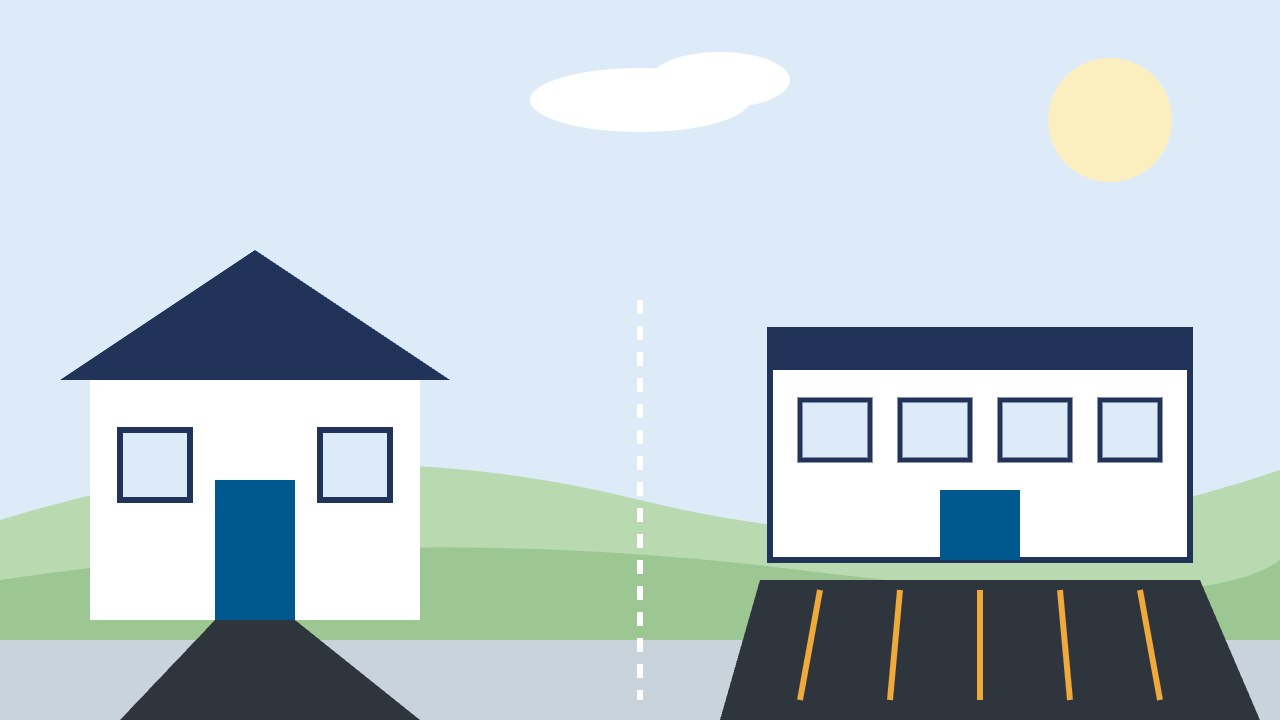
Many paving websites talk to one imaginary customer who wants “all your paving needs” handled. Real customers come in two kinds, and they have little in common. A homeowner wants a driveway. A property manager, business owner or HOA board wants a parking lot or a private road. Marketing that tries to speak to both at once usually lands with neither.
This is our own framework from working with paving contractors, not an outside standard. It has no benchmark numbers, because the right ones are your own.
How the two customers differ
| Driveway | Parking lot or private road | |
|---|---|---|
| Who decides | One household | An owner, a manager or a board, often with someone else approving the money |
| How they look | A search on a phone, a neighbor’s recommendation, a yard sign | A search, a referral from another property, a request for bids |
| What they ask | What will it cost, how long will it last, when can you start | Can you work around our tenants, what is the plan for drainage and striping, are you insured |
| What they need to see | Photos of driveways like theirs, local reviews, a clear estimate | Comparable jobs, proof of insurance, a written scope, references they can call |
| How long it takes | Often decided soon after the estimate | Can run through a budget cycle or a board meeting |
| What comes after | Sealcoating, and the neighbors | Maintenance on a schedule, and their other properties |
The website: two front doors
- A residential page and a commercial page, each linked from the top of the site. The driveway page shows driveways. The commercial page shows lots, and names the kinds of property you’ve worked on.
- Different forms. A homeowner needs name, address and what they want done. A property manager should be able to say how many square feet or spaces, whether the lot has to stay open, and when a decision is due.
- Different proof. Reviews carry the driveway page. The commercial page needs a short list of completed jobs with the type of property and what was done.
Search and ads
- Google Business Profile. List residential and commercial services separately, and post photos of both.
- Google Ads. Run driveways and parking lots as separate campaigns with separate budgets and pages. The setup is in Google Ads for paving contractors.
- Beyond search. Commercial work often starts somewhere else: a property management company’s vendor list, a local apartment or building owners group, a general contractor who needs a paving sub. A one-page capability sheet with insurance details and past jobs is worth having ready for those.
Follow-up
Driveways: send the written estimate the same day and check in within a few days. A homeowner comparing three bids decides while the visits are fresh.
Parking lots: ask at the site visit who else has to approve the job and when they meet. Then follow up on their calendar, not yours. A quote sent in March for a budget approved in June needs a note in May.
What to track
- Record every lead as residential or commercial at the first call.
- Count estimates and signed jobs for each, by where the lead came from.
- Look at the two separately. A source that fills the driveway schedule may send no commercial work at all, and the reverse.
If you want more of one kind
Decide which one, and say so. A contractor who wants commercial work and leads the site with driveway photos will keep getting driveway calls. Put the work you want at the top of the home page, in the first line of the Google profile description and in the ads.
For the service that brings both kinds of customer back, see marketing sealcoating. Homeowners also need to know you’re not a fly-by-night crew: see how an honest contractor shows he isn’t a paving scam. Want help splitting the two on your site? Build a growth plan with us, or see our paving marketing page.